
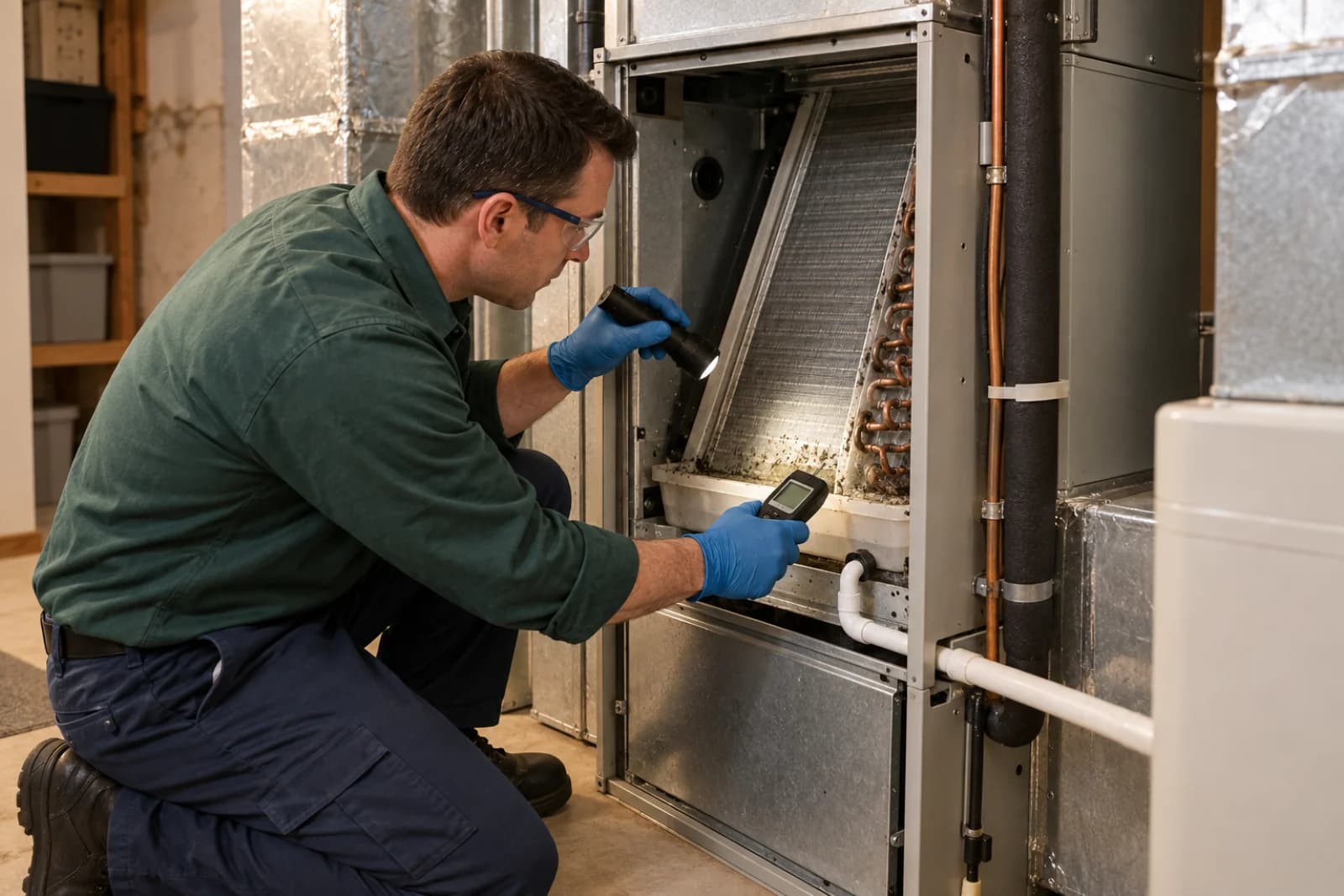
Mold in Air Ducts & HVAC Systems: Causes, Signs & What to Do
Mold in an HVAC system usually starts at the air conditioner's evaporator coil or condensation forming inside ductwork that runs through an unconditioned space — and once it's there, EPA is direct that "the HVAC system has the potential to spread mold throughout a building" every time it runs. This is a different mechanism than basement or attic mold: it's about condensation and airflow inside mechanical equipment, not moisture in a building cavity.
How mold gets into a heating/cooling system
- The AC evaporator coil — the coil runs cold enough to condense moisture out of the air, and EPA identifies this condensation as "a major factor in moisture contamination" in HVAC systems. A key moisture-control step is straightforward: making sure the drain pan under the coil slopes toward the drain and the drain flows freely, so water doesn't stand under the coil.
- A clogged or disconnected condensate drain line — the coil is designed to drain condensation away; a clogged or poorly sloped line lets water pool in the unit instead of draining, which is exactly the standing-water condition EPA's guidance calls out.
- Ducts running through unconditioned spaces without proper sealing and insulation — per EPA, ducts passing through an attic, crawl space, or other non-air-conditioned area need to be properly sealed and insulated "so moisture due to condensation does not enter the system." A duct that isn't sealed and insulated matters — condensation forms on or inside it, the same way it would on a cold glass of water on a humid day.
- Duct insulation that's absorbed moisture — EPA's guidance here is blunt: insulation inside ducts that's gotten wet or moldy "cannot be cleaned effectively" and should be removed and replaced, not treated in place.
Why HVAC mold is different from other mold in your home
Basement and attic mold stay largely where they start until someone disturbs them. A moldy HVAC system doesn't — EPA states plainly that the system "has the potential to spread mold throughout a building" every time it runs. That's the real reason to take it seriously even before anything is obviously visible or smellable: a mold problem inside mechanical equipment is a whole-house exposure issue by design, not a single-room one. EPA also notes that known or suspected mold growth in ducts or other HVAC components "should be investigated and resolved promptly."
Signs to watch for
- A musty smell that's noticeably stronger right when the heat or AC kicks on, and fades when the system isn't running
- Visible dark spotting around supply vents, or on the visible parts of the coil/cabinet if you can access it
- Excess moisture or standing water near the indoor unit or condensate drain line
- Allergy or respiratory symptoms that seem to track with when the HVAC system is running — though EPA is careful to note that duct cleaning itself "has never been shown to actually prevent health problems," so if anyone has ongoing unexplained symptoms, that's a conversation for a doctor, not something to assume gets solved just by cleaning ductwork
What to do about it
Per EPA guidance, routine duct cleaning isn't necessary for most homes — the agency doesn't recommend cleaning ducts on a schedule, only as needed. Substantial visible mold growth inside ducts or on other components is one of the specific situations EPA says warrants it, alongside pest infestation or heavy dust and debris buildup. Visual identification alone often isn't enough to confirm mold, either — EPA notes that a positive determination usually requires an expert and lab analysis, not a guess based on what a stain looks like.
Whatever the diagnosis, fixing the moisture source matters more than the cleaning itself: EPA is direct that if the condition causing the mold in the first place isn't corrected, the mold comes back regardless of how thorough the cleanup was. This isn't a DIY project the way a small surface patch might be — see DIY Mold Removal vs. Hiring a Professional for that general line — because HVAC interior components like coils and ductwork sit past where a homeowner can safely inspect or treat on their own.
Not sure if it's your HVAC system or something else in the house?
An inspection can confirm where the mold is actually coming from before you pay for duct work that may not be the real fix — see Mold Inspection & Testing.
Sources: EPA, "Mold Course for Environmental and Public Health Professionals," Chapter 2 (HVAC systems and mold spread, cooling-coil condensation, duct sealing/insulation) · EPA, "Should You Have the Air Ducts in Your Home Cleaned?" (when duct cleaning is warranted, moisture control, health-claim limits) · EPA, "A Brief Guide to Mold, Moisture and Your Home" (moisture-source-first principle, already cited elsewhere on this site)
Last updated 2026-09-29